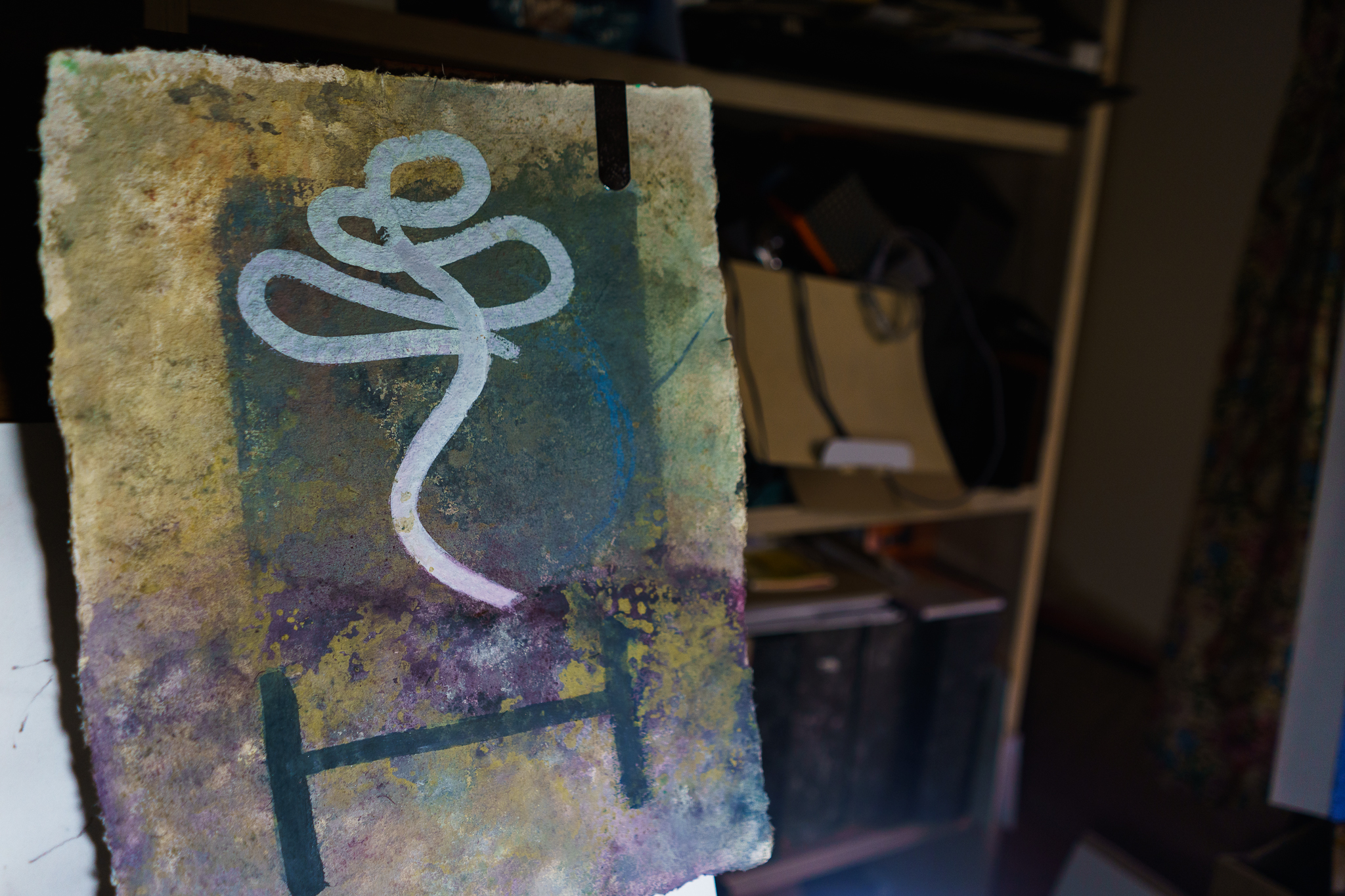
quietitude


I don’t plan it.
When I’m outside the saying of it,
I get very quiet and rarely speak at all.

“Who says words with my mouth?” Rumi.


oil pastel on card, 150 x 200 mm, 2013

oil pastel on card, 150 x 200 mm, 2013

well

pencil in sketchbook, a5, 2013

pencil in sketchbook, a5, 2013


i did a day daytrip across the river, to the kossov exhibition here and to the wellcome trust (here).

kossov was interesting, i still find indifference in bits n pieces of his work but the occasional one is great. so frenetic they can be hard to look at – not helped by the way they are hung in this exhibition. such determination. to see?


the wellcome trust is full of some great things on display, interesting organisation

day

pastel on card, 105 x 185 mm, 2013

pastel on card, 105 x 185 mm, 2013

of course the reformation happened in the spirit of high millenniarlism… the last judgement was expected. very different to the various forms of apocalypse on offer in this day & age. virtually nothing to be said for any similarities with the obvious exceptions that both involve the obliteration of the material world and both have broad (& frequently tedious) ethical standpoints attached.

could one compare murdoch to luther? he’d like that perhaps


i only started this book to clear the book shelf but it’s fat. and draining

ideologies

Prisons are built
with stones of Law, Brothels with bricks of Religion./ As the caterpillar
chooses the fairest leaves to lay her eggs on, so the priest lays his curse on
the fairest joys

William Blake, Marriage of Heaven and Hell.

reading on the reformation is lowering my opinion of [... ...] everything. makes me contemplate the why’s and wherefore’s of burning heretics, and why – current – english society does not burn heretics

something to do with progress and reason (must be frustrating)

being reasonable

oil on reclaimed wood, 260 x 590 x 20 mm, 2013

oil on reclaimed wood, 260 x 590 x 20 mm, 2013

feed

watercolour on paper, 230 x 420 mm, 2013

watercolour on paper, 230 x 420 mm, 2013


Twelve design principles of permaculture (as taken from the wikipedia page).

Generally regarded as the following:

  1. Observe and interact: By taking time to engage with nature we can design solutions that suit our particular situation.
  2. Catch and store energy: By developing systems that collect resources at peak abundance, we can use them in times of need.
  3. Obtain a yield: Ensure that you are getting truly useful rewards as part of the work that you are doing.
  4. Apply self-regulation and accept feedback: We need to discourage inappropriate activity to ensure that systems can continue to function well.
  5. Use and value renewable resources and services: Make the best use of nature’s abundance to reduce our consumptive behavior and dependence on non-renewable resources.
  6. Produce no waste: By valuing and making use of all the resources that are available to us, nothing goes to waste.
  7. Design from patterns to details: By stepping back, we can observe patterns in nature and society. These can form the backbone of our designs, with the details filled in as we go.
  8. Integrate rather than segregate: By putting the right things in the right place, relationships develop between those things and they work together to support each other.
  9. Use small and slow solutions: Small and slow systems are easier to maintain than big ones, making better use of local resources and producing more sustainable outcomes.
  10. Use and value diversity: Diversity reduces vulnerability to a variety of threats and takes advantage of the unique nature of the environment in which it resides.
  11. Use edges and value the marginal: The interface between things is where the most interesting events take place. These are often the most valuable, diverse and productive elements in the system.
  12. Creatively use and respond to change: We can have a positive impact on inevitable change by carefully observing, and then intervening at the right time.


applicable as design principles – long term, nourishing; timeless design principle – across human activity.

any complaints or changes need making – let me know.

prussian

prepare

Everything depends on the ideas, and the quality of the…I call it the culture…the regeneration of the world. There is what one calls in the past in German the Gesamtkunstwerk

Joseph Beuys, 1982 interview with Dušan I. Bjelić

.

see here for a more useful interview: https://www.youtube.com/watch?feature=player_embedded&v=lTqcgiXcgjM

pencil and pastel in sketchbook, a5, 2013

pencil and pastel in sketchbook, a5, 2013

what it is to prepare for survival – permaculture

reform

The study of the powers that shape, maintain and alter the state is the basis of all political insight and leads to the understanding that the law of power governs the world of states just as the law of gravity governs the physical world.

Realpolitik as devised by Ludwig von Rochau.

to be fair to him he saw realpolitik as a pragmatic approach to politics - i understand it as an approach to politics which enforces the paradigmatic governing doctrine

oil on reclaimed wood, 260 x 970 x 20 mm, 2013

detail, oil on reclaimed wood, 260 x 970 x 20 mm, 2013


i’m reading a book on the reformation – - ‘reformation’ by diarmaid macCulloch – - incidentally  a beautifully written book and fascinating; filled in a lot of the obscurities of christian nomenclatur for me. what it hasn’t done is improved my opinion of christianity as an organised religion – - the opposite probably.

another thing it has done is made me think on monarchy


the monarchs of the reformation killed any perceived opposition without question – enforcing their own realpolitik by burning at the stake – - burning alive – - anyone who even implied that it might be possible that a monarch’s word was not backed by the word of their god. not to mention organising armies to rape n pillage across europe at the drop of a doctrinal detail. doctrine is all


hard

It means nothing to me. I have no opinion about it, and I don’t care.

Picasso on the first moon landing, quoted in The New York Times, & wikiquote.

i’ve been speculating on what it must have been like to have worked in an art world with picasso in it…

it must have been hard work. especially since one of his great talents was doing other peoples ‘art genus’ better than them. so when i wander around exhibitions in london where his — sorry — where exhibitors insist on displaying his, some of his, best work — ‘the vollard suite’ for example. that is: a few examples taken from ‘the vollard suite’

hoping to punt on a picasso print here & there is a worthy occupation

placing other work in the same room as a picasso print can be dicey. it’s easy to come a cropper, and totally forgivable if the other work might fade a little in comparison; a particular sort of bloodlessness – i mean – against a picasso other work may look as though it may be bloodless or lacking in blood. but then maybe — and here i wonder whether the question should even be put into words, perhaps it should not be offered up, there being no place for it — should ‘blood’ be in it

charcoal on paper, 350 x 250 mm, 2013

charcoal on paper, 350 x 250 mm, 2013


the work above is available as a print here: http://www.frcontemporary.com/en/shop/index.php

Follow

Get every new post delivered to your Inbox.

Join 184 other followers